


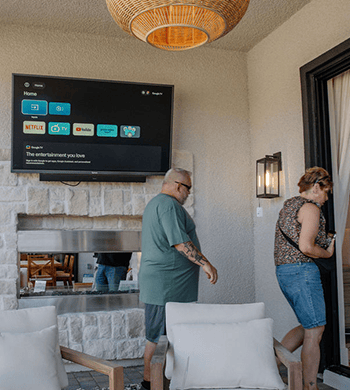

Search outdoor tv vs projector reddit threads and the same conclusion keeps coming up: pick based on when you watch, not just price or screen size. Daytime and mixed-light viewing calls for an outdoor TV. Night-only, fully shaded viewing is where a projector still works. The most repeated complaint is a projector image that goes washed out the moment ambient light hits it — and the second most common one is timing: most live sports air in daylight or early afternoon, exactly when a projector performs worst. This guide walks through daylight visibility, weatherproofing, setup, sound, and screen size, so you can match your patio to the right screen. Already sure you want something that works day and night? Browse our outdoor TV lineup.
Can You Use a Projector Outside During the Day?
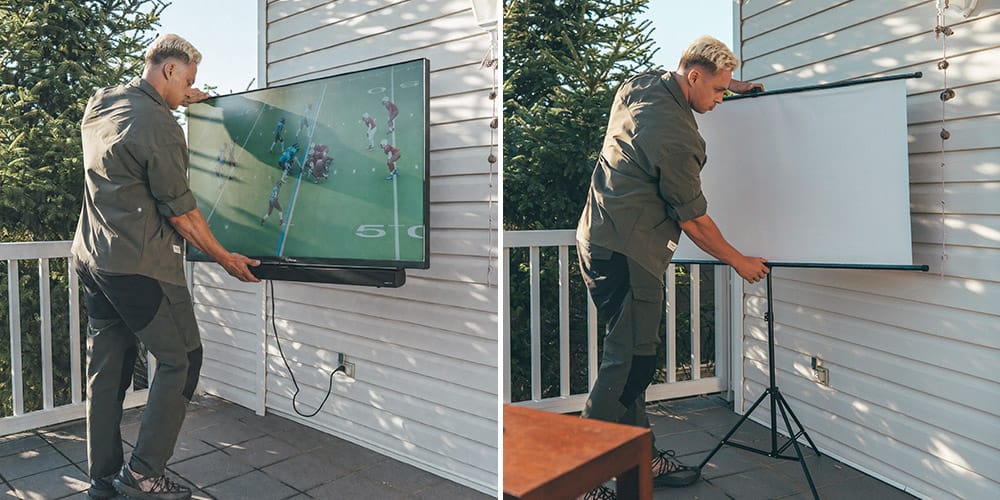
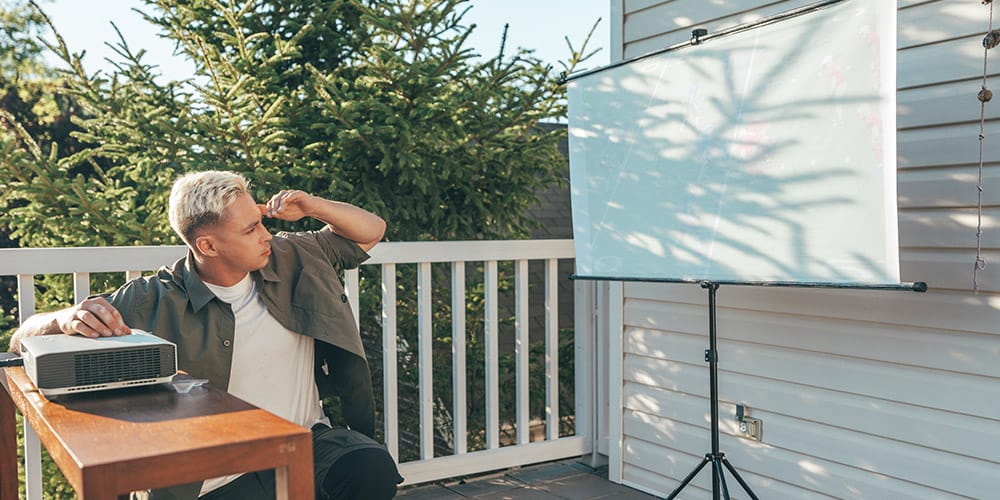
Short answer: a projector can work outside during the day only in deep shade, but it will not deliver a bright, clear picture. Sunlight and ambient light wash out the reflected image, so colors look flat and details disappear. That is why projector barely visible complaints are common on sunny patios. Reddit threads raise a second, related frustration: most live sports — NFL, college football, golf — air during the day or early afternoon, exactly when projectors struggle most. If weekend games are the main use case, that scheduling conflict alone often settles the outdoor tv vs projector decision.
Projector Lumens vs TV Nits: What's the Real Difference
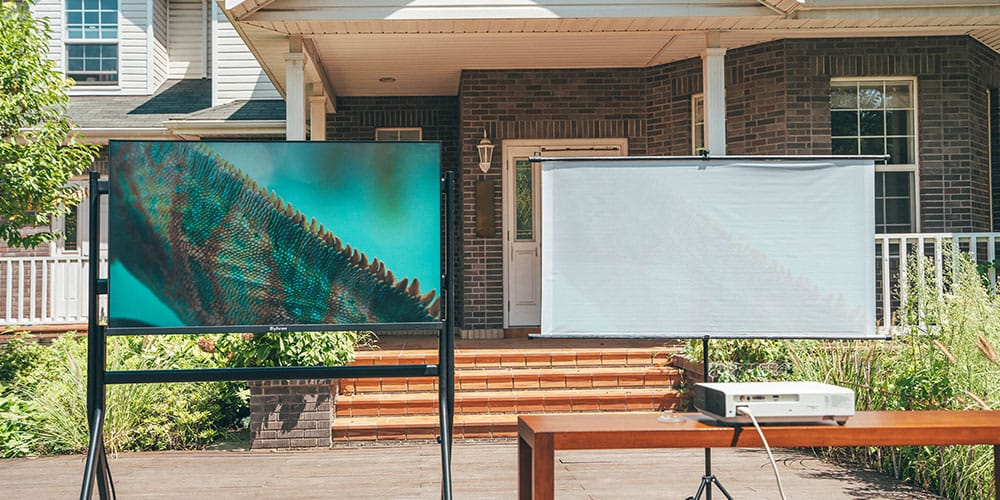
Projector brightness is measured in lumens, the total light leaving the lens. Outdoor TV brightness is measured in nits, light hitting your eyes per square inch of screen. Lumens vs nits isn't a direct conversion, but here's a rough guide: 3,000 lumens spread across a 100-inch screen works out to roughly 875 nits. An entry-level outdoor TV starts around 1,000 nits already. Even a bright projector loses ground once the image gets that large. For daylight viewing, that gap only grows as the screen size goes up.
How Bright Does an Outdoor Projector Need to Be?
For outdoor daytime use, you need at least 3,000 lumens, plus real shade over the screen. Skip the shade, and the picture stays washed out no matter how much you crank the brightness of the projector. Shopping for an outdoor projector for daylight use? Even a UST projector paired with an ALR screen still needs shade to stay watchable — brightness alone doesn't solve ambient light. Outdoor TVs solve this with two brightness tiers: Partial Sun outdoor TVs (700–1,000 nits) for covered patios, and Full Sun outdoor TVs (1,500–5,000 nits) for open spaces with no shade. Compare both in our Partial Sun vs Full Sun Outdoor TVs guide.
| Light Condition | Projector | Outdoor TV |
|---|---|---|
Fully shaded | Watchable | Any model works |
Partially shaded | Barely visible | Stays clear in partial-sun areaswith a 700–1,000 nit outdoor TV |
No shade | Not visible | Remains sharp in full-sunspaces with a 1,500–5,000+ nit outdoor TV |
An outdoor projector or TV comparison for daytime viewing isn't close. If you're trying to make a projector brighter, more lumens and less ambient light help — but you're still fighting the sun.

Sun Direction and Shade: What Matters for Your Space
Before picking a screen, look at how your patio actually gets sun. East-facing spaces get harsh direct sunlight in the morning; west-facing walls take it in the afternoon, right when most people watch. A covered patio, sail shade, mature trees, or a louvered roof all cut that exposure and open up more options, including a partial sun outdoor TV and a projector. Full sun with no structure overhead usually rules out a projector entirely and points straight to a full sun outdoor TV instead. Walk your space at the times you'll actually watch, not just at noon.
Weatherproofing: Outdoor Projector vs Outdoor TV
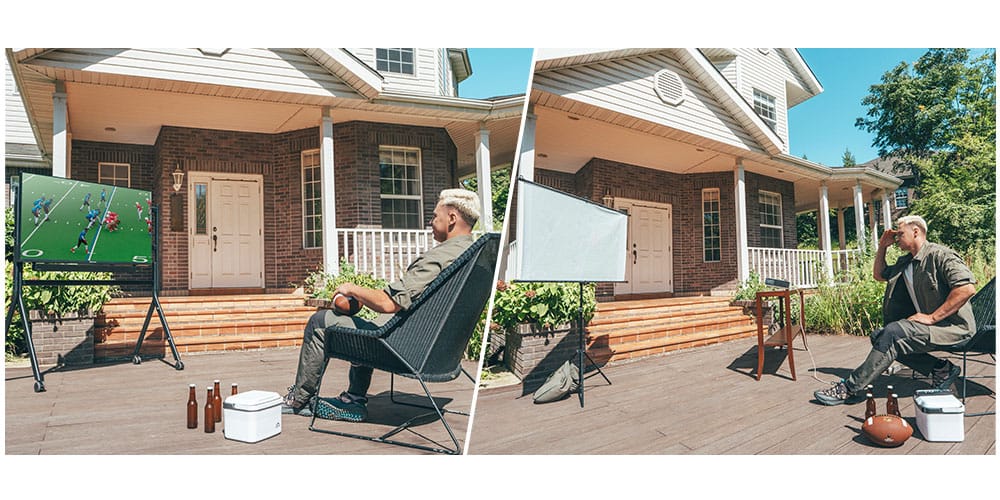
Outdoor TVs are built to live outside permanently. Outdoor projectors and their screens are not — both typically need a cover, enclosure, or fully shaded location to survive rain, humidity, and dust long-term.
| Protection Dimension | Outdoor Projector | Outdoor TV |
|---|---|---|
IP Rating(dust & water-resistance) | IPX2 / IPX4; some models offer IP54 | IP55 to IP56-rated protects against heavy rain, humidity & dust |
Enclosure Needed | Yes — projector box or Storm Shell typical | No, weatherproofing is built in |
Wind Exposure | Screens sway or vibrate when it's windy | Fixed mount holds steady |
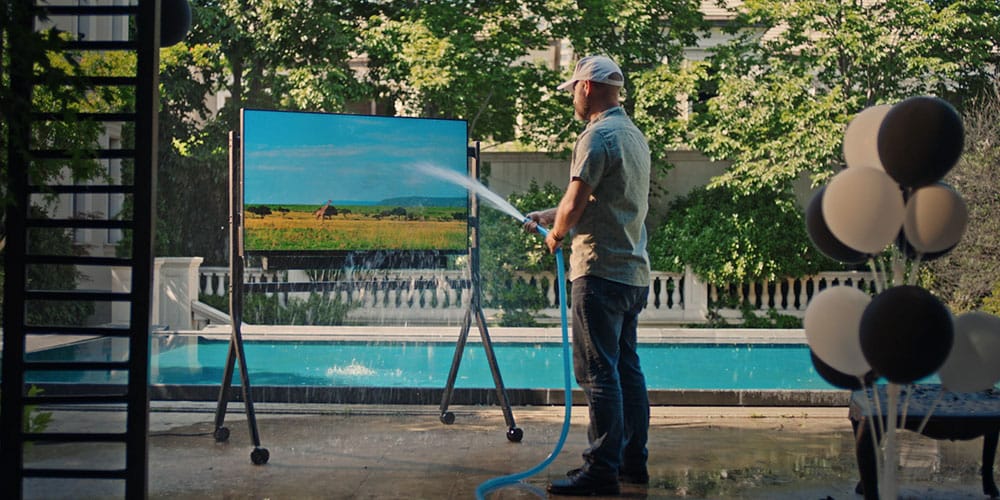
Projectors used outdoors usually need a covered patio, dedicated shade, or sail shade just to keep the lens and electronics dry — protection an IP56 rated outdoor TV doesn't require. For a full breakdown of what IP ratings and operating temperatures actually mean, see our outdoor tv specs guide.
Screen Size and Viewing Distance: How Big Can You Go?
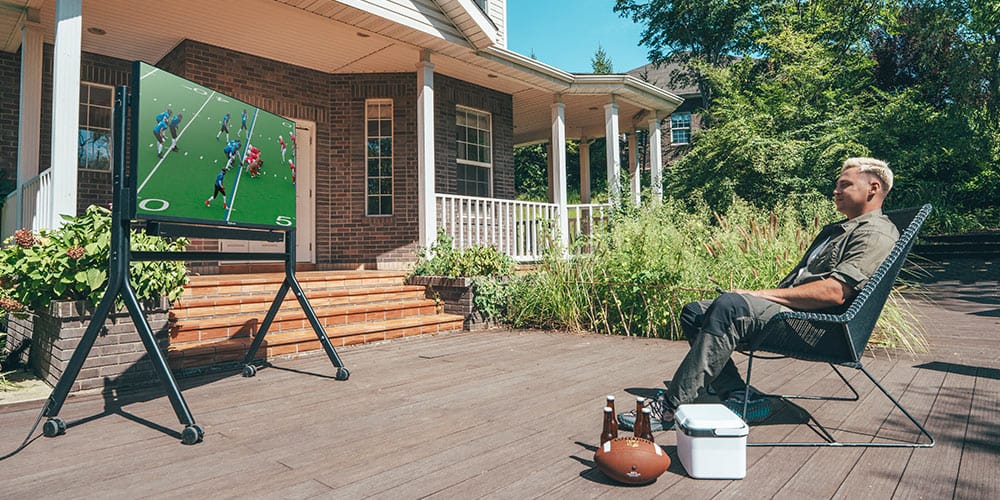
On paper, a projector still wins the size argument in the outdoor tv vs projector comparison. Projectors can throw a 100” to 166” image, while many outdoor TVs sit in the 75” to 98” range. But size only matters if the picture stays visible: a 150-inch projected image can look pale in daylight, while a smaller outdoor TV remains easier to watch because it produces its own brightness. Bigger is not automatically better for daytime viewing. If you still want an oversized screen without switching to projection, Sylvox also offers a 110-inch outdoor TV for large backyard and patio setups.
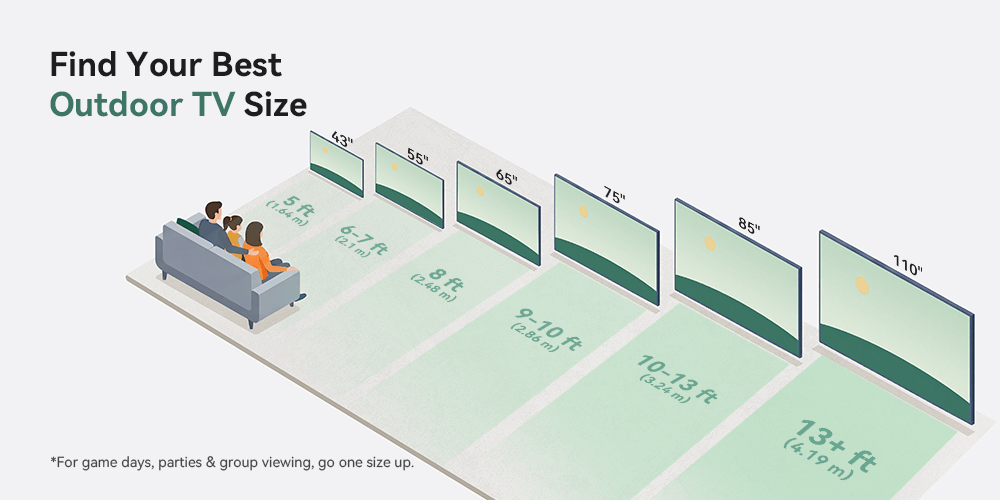
As a rough rule, sit no closer than about 1.5 times the screen's size for comfortable outdoor viewing. Use the graphic below to match outdoor TV screen size to your patio and seating distance.
Setup and Ease of Use: Projector vs Outdoor TV
Both a projector vs TV for outdoors setup can be permanent or portable. The gap shows up once you actually use them. A projector's picture depends on three things staying aligned: the unit's position, the throw distance, and the screen. Move one, and the others need adjusting too. An outdoor TV is one unit — point it, mount it, done.
Permanent Installs
A permanent outdoor projector screen, the motorized, wall-mounted kind, runs $1,500 to $2,500 and up. You'll still need tab-tensioning to fight wind and a real weatherproof rating for moisture. A cheaper outdoor projector screen with a stand costs $40 to $85, but it shifts in a breeze, which throws off focus mid-movie. Either way, the screen's angle is fixed once it's up. An outdoor TV on a mount adjusts angle any time glare or seating changes. Sylvox's outdoor TV installation guide covers wall and ceiling mounting steps in detail.
Moving It Around
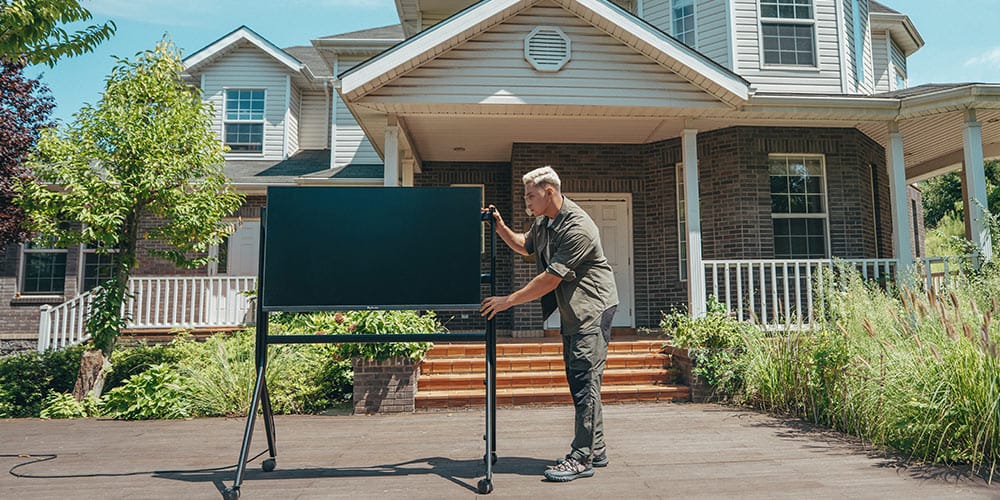
Relocating a projector means realigning the unit, the screen, focus, and keystone correction, every time. Portable screens catch wind too, so stability suffers. For an outdoor TV, just push the installed TV and lock on the wheels with a rolling TV cart. No recalibration required.
| Setup Type | Projector Steps | Outdoor TV Steps |
|---|---|---|
Permanent | Mount unit > mount screen > align > tension | Mount screen > done |
Portable | Reposition unit and screen > refocus | Roll cart > lock wheels |
Outdoor Audio: What Each Setup Actually Requires
Indoors, a projector's 5–10W speakers get by. Outside, sound has nowhere to bounce off, so it just disappears. That gap is why so many people search projector audio not working or no sound on projector — the speakers were never built for open air. Getting sound from a projector to speakers wirelessly, or figuring out how to get sound on a projector from a laptop, adds setup steps most people don't expect at purchase. You may end up buying a projector and soundbar, or a full projector sound system, just to hear dialogue in an outdoor seating area. That's a real audio system for projector cost stacked on top of the screen.
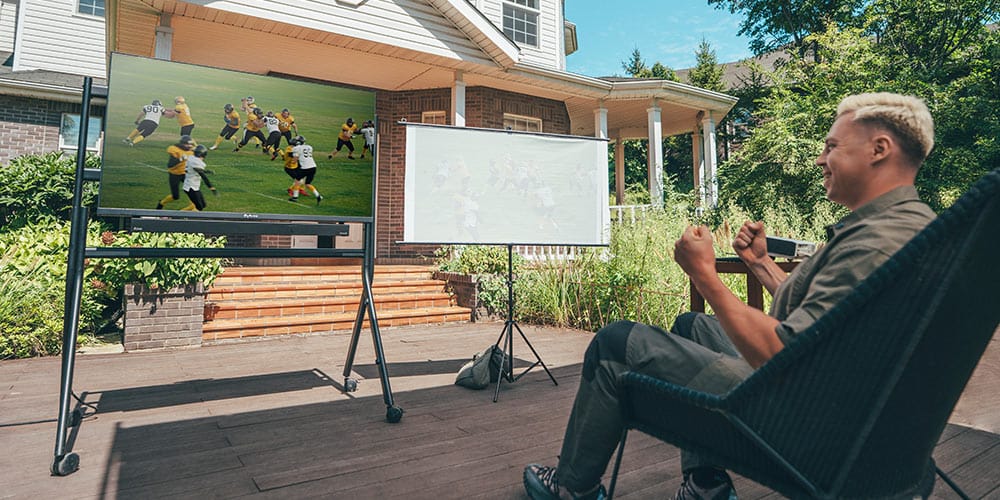
An outdoor TV skips this step entirely. Built-in speakers are already sized for open-air spaces. No wiring, no pairing, no extra line item. Want more volume for a crowd? An outdoor soundbar pairs with either setup, but only an outdoor TV works fine without one. By the time you've priced out a bright projector, an ALR screen, lens, mounting box, and a sound system, the total often creeps well past what you budgeted — one more reason costs are harder to predict with an outdoor projector setup than with a single outdoor TV.
| Setting | Projector Needs | Outdoor TV Needs |
|---|---|---|
Small patio | External speaker recommended | Built-in speakers sufficient |
Open backyard | Sound bar required | Built-in speakers usually enough |
Large gathering | Full sound system | Outdoor soundbar optional |
Which One Is Right for You? Outdoor TV or Projector
Across outdoor tv vs projector reddit threads, daylight visibility and sports timing come up more than any other factor. There's no single winner in the outdoor TV or projector debate. It depends on how and where you watch. Are projectors better than TVs for an occasional movie night in a dark backyard with a huge screen? Yes. For daily use, daylight hours, or a screen that stays up year-round, an outdoor TV wins.
| Choose a Projector If… | Choose an Outdoor TV If… |
|---|---|
You watch mostly at night | You watch day and night |
Setup is occasional, not permanent | You want a fixed, ready screen |
Full shade or darkness is available | Your patio gets sun exposure |
You want a 120”-plus screen | You want simple, low-maintenance viewing |
You don't mind extra audio gear | You want sound that works out of the box |
You never watch live sports during the day | You watch live sports or golf in daylight |
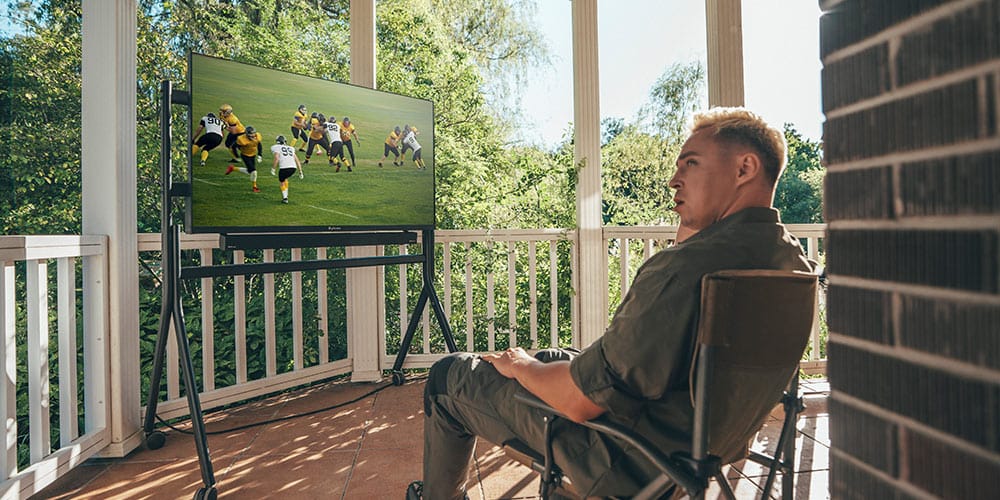
Game day is where an outdoor TV pulls further ahead. Sylvox's Gaming Series and Cinema Series outdoor TVs use higher refresh rate panels built for fast-moving sports and action, so a soccer counterattack, a long football pass, or a baseball swing stays sharp instead of blurring — something a standard projector's refresh rate can't match outdoors.
Most backyards lean toward daytime, weekly use, not occasional dark-night viewing. That's why an outdoor TV is the more practical pick for most patios and pools.
TV or Projector for Outdoor Use FAQs
1. Outdoor projector vs TV: which costs less?
A projector may cost less by itself, but the budget can get out of control once you build a setup that actually fights daylight. A high-lumen projector, quality screen, lens, mounting box, and audio system can quickly push the total above an entry-level outdoor TV; LED panels or video walls can cost even more because they usually require structural installation.
2. Can an outdoor projector work if it's not dark out?
It can turn on, but visibility drops fast in daylight. You'll need 3,000+ lumens and shade to keep it usable before dusk.
3. Projector vs smart TV: do I need both?
An outdoor TV can already run smart apps; for example, Sylvox outdoor TVs include a built-in Google TV system for streaming and live channels. Traditional projectors need a separate streaming stick, cable box, laptop, or smart TV source connected before you can watch.
4. How do I have an outdoor movie night without a projector?
Mount an outdoor TV and stream from its built-in apps. No screen, no alignment, no waiting for dark. For most patios, an outdoor TV is the more practical projector alternative for outdoor movie nights.
5. Outdoor TV vs outdoor projector: which holds up better outside?
Outdoor TVs use sealed, weatherproof housings built for long-term outdoor installation. Projectors and their screens are more sensitive to humidity and wind. Most projectors also need to be stored indoors after use to prevent outdoor conditions from damaging the unit.
6. How do outdoor TVs and projectors compare for summer movie nights?
For an occasional summer movie night after dark, a projector's bigger image can feel more like a real theater. But factor in bugs, humidity, and the daylight that lingers into early evening — anyone watching more than a few nights a month usually ends up happier with an outdoor TV.

Ready to Set Up Your Backyard Cinema?
For an occasional movie night in full shade, a projector still works. For daytime use, patios, poolside setups, or anything permanent, an outdoor TV is the safer, more reliable investment — better brightness, a simpler install, and sound that's ready out of the box.
Browse Sylvox outdoor TV lineup
Watch how to install outdoor TV
Check do you need a special tv for outside before you buy.


Leave a comment