


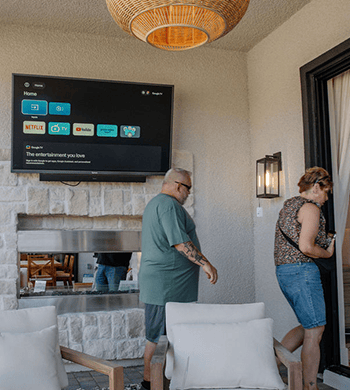

A west-facing patio with prolonged direct, unobstructed sunlight during the 4–6 PM window needs a 2,000-nit full sun Sylvox outdoor TV like the Pool Pro 3.0, not a 1,000-nit partial-sun model like the Deck Pro 3.0, because low-angle sunlight hits the screen nearly perpendicular, creating reflection that mid-range brightness cannot overcome.
The 1,000-nit tier handles covered patios and morning or evening viewing comfortably. But if your 5 PM check shows the screen sitting in strong light for a sustained stretch, that becomes the deciding factor. Here's how to assess your own conditions first.
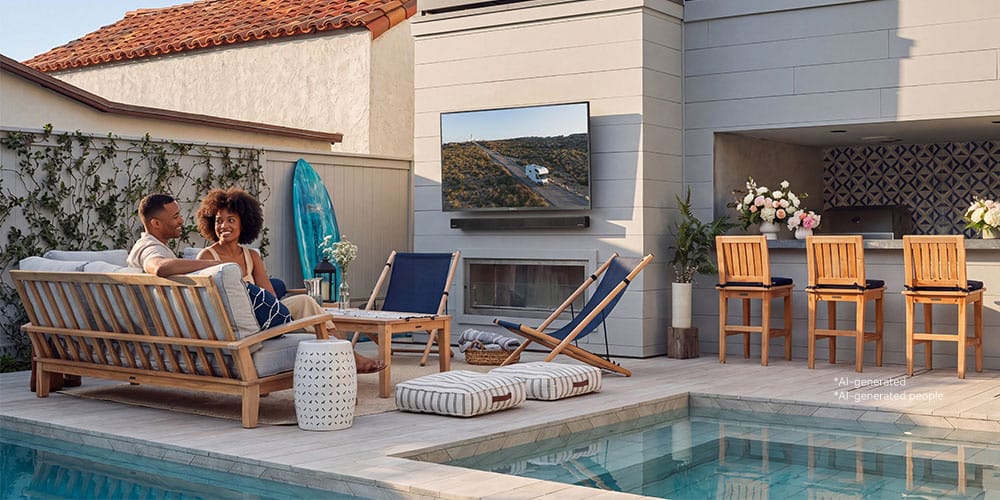
Why West-Facing Patios Hit Peak Glare at 5pm
A west-facing patio gets the worst possible light for TV viewing. Mornings are shaded and comfortable, but by early afternoon the sun is descending toward the western horizon — directly into your sightline.
At noon the sun sits high overhead and its light hits the screen at a steep angle that mostly bounces away. Between 4 PM and 6 PM, though — depending on latitude and season — it drops to roughly 20–30 degrees above the horizon. At that angle light strikes the screen nearly perpendicular to the glass, producing maximum reflection and washing out the image.
A typical indoor TV puts out 300–500 nits; in those conditions it's unwatchable. An outdoor TV is built to solve this, but different tiers solve it to different degrees. If you're still deciding which model fits your setup, this guide to choosing the right outdoor TV by space walks through shaded patios, poolside areas, and full-sun backyards scenario by scenario.
The 5 PM Glare Test: 3 Steps to Assess Your Installation Spot
Spend two or three days observing your patio — about 15 minutes a session, and it tells you more than any spec sheet.
Step 1: Pick three observation windows. Do this at 10 AM, 2 PM, and 5 PM on a clear day. Those cover the range you'll actually watch in: shaded morning hours, high overhead sun at midday, and the low-angle western sun that decides which brightness tier you need.
Step 2: Use a simple glare test. Place a dark-colored object—a black T-shirt or dark towel—where the TV will go. If you can still see its texture clearly from your seating position, that spot is manageable. If it looks flat, pale, or shiny instead, light is landing hard enough there to wash out a screen in the same position. That's the worst case your brightness choice has to clear.
Step 3: Check the sun's position relative to your seating. Sit where you'll actually watch. Sun behind you means it's hitting the screen directly — worst case. Sun off to one side, and your roofline or pergola may block part of it. Sun behind the screen depends on what's back there: with a solid wall or building behind the TV you're in good shape, but on a rolling stand or in an open pergola with nothing solid behind it, the sun is now in your eyes instead — uncomfortable to watch even when the picture is fine.
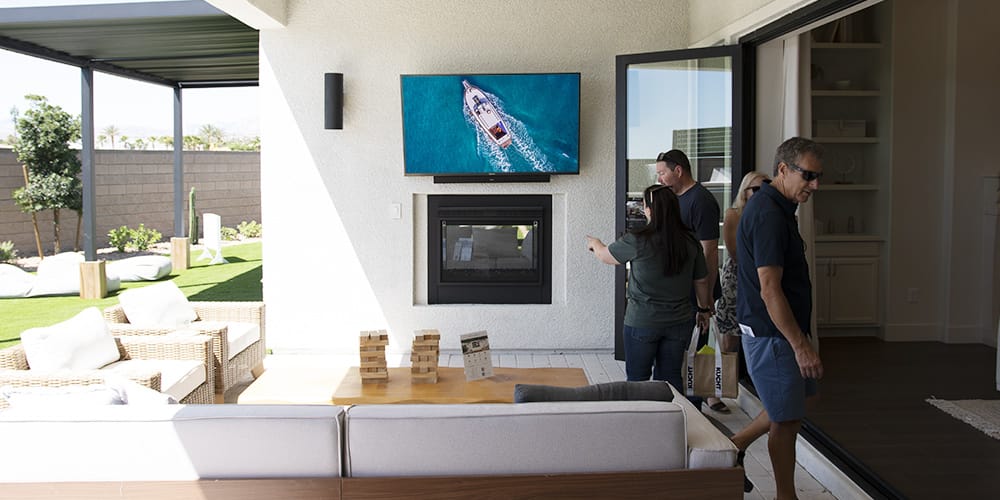
After three sessions, you're looking for one spot with three things:
- No direct light hitting the screen during the hours you watch
- Something solid behind the screen
- Nothing highly reflective in front of it
If low-angle sunlight still reaches the screen from the west, putting up outdoor curtains on the west side can cut direct glare during the 4-6 PM window and help a 1,000-nit TV hold up better. Meet all three and a 1,000-nit outdoor TV will serve you. Miss any one during the 4–6 PM window and plan on a 2,000 nits outdoor TV.
Decision Thresholds: When 1,000 Nits Is Enough, When You Need 2,000
Here's the decision framework, based on your observation:
Choose a 1,000-nit Sylvox outdoor TV if: your patio is covered by a solid roof or dense pergola, you watch mostly in the morning or after sunset, and the screen stays shaded through your normal viewing hours. The Sylvox Deck Pro 3.0 sits in this tier and starts at $1,149 for the 43” model, making it the value pick for covered spaces.
Choose a 2,000-nit outdoor TV if: the screen sits in high ambient brightness during your normal viewing hours, you plan to watch afternoon sports or weekend games, or your patio has reflective surfaces like a pool or light-colored stone that raise the light level around the screen. The Sylvox Pool Pro 3.0 doubles brightness to 2,000 nits and is built for full-sun settings like poolside and rooftop decks.
The rule of thumb: if you squint during your 5 PM check, go with 2,000 nits. For a deeper brightness-tier breakdown, this guide to how many nits for outdoor TV explains what full-sun and partial-sun setups really need.
Anti-Glare Screen: The Overlooked Differentiator
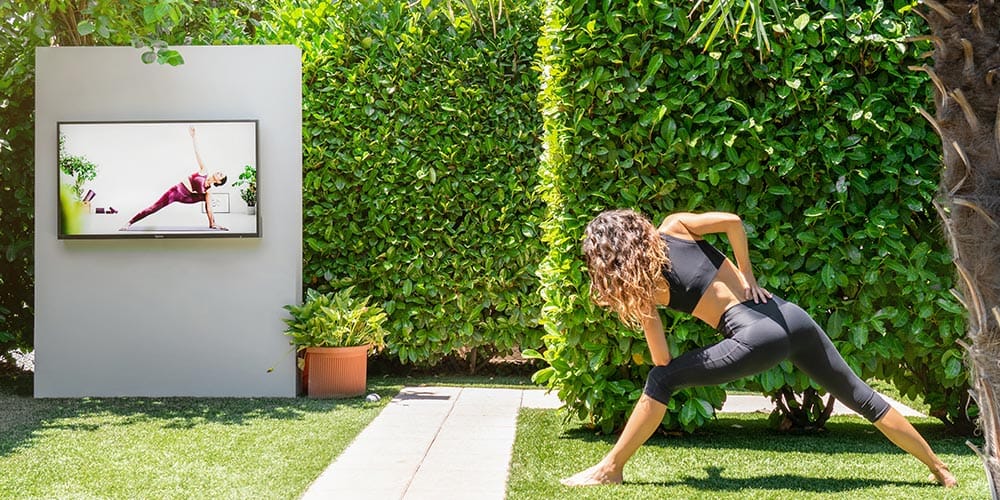
Here's what most buyers miss: brightness alone doesn't solve glare. A 2,000-nit screen with a glossy surface still reflects sunlight. The real fix is an anti-glare matte display that diffuses reflected light instead of bouncing it back at you.
Sylvox offers it as a variant on both the Deck Pro 3.0 and the Pool Pro 3.0. Instead of a sharp mirror image of the sun, you get a diffuse glow that's easier to look past.
The two variables do different jobs: brightness lifts the picture above the ambient light level, while a matte finish deals with what the surface bounces back. On a west-facing patio both are in play at once, so check each rather than assuming a higher nit number covers everything.
Additional Features That Matter for West-Facing Patios
Beyond brightness and anti-glare, three features matter for west-facing patios:
- Operating temperature range. Every Sylvox outdoor TV operates from -30°C to 50°C (-22°F to 122°F). A west-facing patio gets strong sunlight for hours, and the temperature inside the TV enclosure climbs well above the air around it. A panel rated only for indoor conditions ages quickly under that load — the wide range is what keeps it working through summer afternoons and winter nights.
- IP56 water resistance. If your patio is covered but open to wind-driven rain, or sits near a pool, IP56 means the enclosure is dust-protected and holds up to powerful water jets. The housing is corrosion-resistant metal, the internal motherboard is coated to resist mold, moisture, and salt air, and the remote is IP66-rated. If you're comparing outdoor TV specs before choosing a model, this outdoor TV specs guide explains what really matters for long-term patio use.
- Viewing angles. Outdoor seating is rarely arranged directly in front of the screen. Sylvox outdoor TVs use LED panels with wide viewing angles, and QLED variants are available in selected sizes and are positioned for enhanced color performance. If your patio has seating spread across a wide area, the QLED upgrade is worth considering.
Your Purchase Decision Checklist
Before you buy, run through this:
1. What's your worst light window?
- Covered or shaded through your normal viewing hours → the 1,000-nit category.
- High ambient brightness for a sustained stretch → the 2,000-nit category.
2. Can you shade the screen?
If you can add a shade sail or curtain for the 4–6 PM window, 1,000 nits becomes viable. If not, 2,000 nits is the safe call.
3. Is there a reflective surface nearby?
Pool, light stone, white concrete → factor in reflected light and lean toward 2,000 nits.
4. When do you actually watch?
Evening-only viewing → 1,000 nits saves you money. Weekend afternoon games → 2,000 nits.
FAQ
Q: Can I just use a regular indoor TV with a cover on my covered patio?
A: No. Indoor TVs lack the IP56 weather sealing needed to survive humidity, rain, and temperature swings. A cover helps with rain but not with corrosion, condensation, or the heat buildup from direct sun. Sylvox's operating range of -22°F to 122°F exists because outdoor environments routinely hit those extremes.
Q: Is 1,000 nits enough if I only watch at night?
A: Yes. If you only watch after sunset, 1,000 nits is more than sufficient, and the Deck Pro 3.0's lower price makes it the rational choice.
Q: Will anti-glare completely remove reflections?
A: No. A matte finish reduces and diffuses reflections, but under direct low-angle sun, no screen is fully reflection-free. Pairing 2,000 nits with a matte finish keeps content watchable.
Q: Does brightness degrade over time?
A: All LED panels lose some brightness over their lifespan, but Sylvox outdoor TVs use higher-grade panels built for sustained high-brightness operation. The full-metal body improves heat dissipation, which helps slow the aging of each light-emitting component over time.
For a west-facing patio, the decision comes down to one question: do you watch during the 4–6 PM window? If yes, a 2,000-nit Sylvox outdoor TV is the best fit.


Leave a comment