


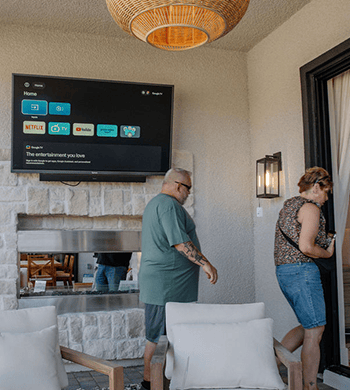

Choose a 65-inch outdoor TV when it fits the main seating group and leaves a practical installation position. Consider 75 inches when the larger picture serves regular viewers better and the wall, mount, and surrounding space can accommodate it. Neither choice wins just because the patio is described as small or large.Start with a sketch of the seats and two screen outlines. The comparison becomes more useful when you can see what the larger television changes: the edges of the picture, the available mounting position, and the space around it. Then compare equivalent models from the same series and generation.
Look at the seating group, not just the middle chair
A row of chairs facing the television presents a different problem from a sectional wrapping around a table. For a centered row, compare how each outline looks from the seats people use most. For a wide arrangement, give the end seats equal attention: adding picture area does not turn a sideways seat into a centered one.Identify the places where people watch continuously and those used for occasional glances. If the dining table is mostly used for meals, it may not need the same priority as the lounge. If everyone watches from the table, build the comparison around that arrangement instead.A Sylvox outdoor TV should fit the seating you intend to keep. Before changing the size, try moving a chair or adjusting the proposed screen position. That may improve a poor side view without making the whole installation larger.Record viewing distance alongside the seating sketch, but use it as one input. For size and seating guidance, see the Outdoor TV Buying Guide. Then compare how each screen fits your regular seats and available mounting space.
Measure the usable wall space
The advertised 65-inch or 75-inch measurement describes the screen diagonal, not the television's width. The housing also occupies space. Use the overall dimensions of the actual products when checking whether they fit, rather than stretching tape across the wall to the advertised screen size.Mark boundaries that cannot move: a door opening, a post, a window, fixed cabinetry, or the end of a usable wall. Then mark the proposed screen center. A larger outline expands around that center, so compare both edges instead of checking only the extra width on one side.Do the same vertically. A larger television can reach farther above and below a shared center line. That matters when there is furniture below or a beam overhead. Raising the whole television to clear a cabinet changes the view from every chair.For a Sylvox patio TV setup, include the bracket and its intended movement in this measurement. A television that fits flat against the wall may need more usable space when turned toward another seating area.
Compare the tradeoffs side by side
Use this table to organize the checks, not as a rule that assigns a size to every patio.
| Layout condition | Check the 65-inch option | Check the 75-inch option |
|---|---|---|
One main seating group | Does the picture feel sufficient from the regular seats? | Does the larger outline improve that experience? |
Seats spread sideways | Can the screen position serve both ends? | Do the end seats gain anything beyond a larger outline? |
Narrow usable wall | Are installation and access spaces preserved? | Do the housing edges approach a fixed obstruction? |
Adjustable mount | Does the intended position remain clear? | Is the full movement range practical? |
Several viewing zones | Which group receives the clearest view? | Does the extra size help without compromising that group? |
Keep a short note for each decision. “The larger outline reaches the door trim” is more useful than “75 looks too big.” Likewise, “the back table gains a more visible picture without moving the screen” gives a concrete reason to keep the larger option under consideration.
How patio, poolside, and bar layouts differ
For a patio with one sofa facing the wall, compare the 65-inch and 75-inch outlines from the regular seats. Keep the 75-inch option only when its larger picture improves that view enough to justify the extra width and height; keep 65 when it leaves more clearance around doors or furniture.For a poolside layout spread across several directions, compare the 65-inch and 75-inch outlines against the main group, a post, and nearby paths. Keep the larger option only when it improves that group view without pushing the housing toward a fixed boundary; a larger screen cannot correct a blocked sightline. At a bar, compare the two sizes from the seats where people actually watch, not just occasional passers-by. Keep the 75-inch option only if it improves the regular viewing group without crowding the service route or forcing furniture changes.Compare each outline with your regular seats and fixed boundaries before choosing a size. The guide to choosing an outdoor TV for your space covers the broader differences between outdoor settings.
Keep the product comparison consistent
When comparing the 65-inch and 75-inch Sylvox Deck Pro 3.0 outdoor TVs, keep both models from the same generation so differences in picture features or housing design are not mistaken for a size difference.Put the two product pages beside one another. Record overall width, height, depth, weight, mounting-hole pattern, and the installation clearances in the relevant manuals. Use the exact variants you would order, not a photograph of a similar model.The Sylvox outdoor TV collection is a starting point for finding those options. A shared series name does not eliminate the need to check the installation details for each size.Ask the installer to assess the television and mount as a pair. A bracket's screen-size range alone is not a complete compatibility check; mounting-hole spacing, weight capacity, mounting surface, and the permitted installation all matter. Make the size decision only after both options pass the same mount, surface, and access checks.
Try both outlines before choosing
Make the comparison with the normal furniture in place. Use the product dimensions for each outline and different tape colors to keep the edges identifiable.
- Mark one proposed screen center and drew both housing outlines around it.
- View the outlines from every regular seat, including the ends of the group.
- Check nearby openings and the space needed for access or adjustment.
- Note which problems change with size and which remain in both versions.
- Reposition the outlines if necessary, then compare the same seats again.
An outline helps you judge physical fitness and visual scale. It does not reproduce picture quality or prove that small on-screen text will be readable. Where practical, compare operating displays as another part of the decision.Choose the Sylvox outdoor TV size that works across the regular seats and fits a viable installation position. Keep the larger option when it provides a useful improvement; keep the smaller option when it already serves the group and fits the space more comfortably.
Questions before placing an order
Can a mock-up based on a product photo replace dimensions?
A photo can be cropped, scaled, or taken at an angle. Build the outline from the published overall measurements instead. If a dimension is unclear, obtain it before using the mock-up to judge a tight space.
What if the seating will change later?
Compare the current layout with the specific arrangement you are planning next. Mark which seats will move and which boundaries will stay fixed. Avoid sizing for an imagined crowd if it compromises the seats you will use every week.


Leave a comment